By Alexander Simes, on October 9, 2014

For those attending SC14 in New Orleans, Louisiana, we will hold the annual “Scalable Adaptive Graphics Environment (SAGE) for Global Collaboration” Birds of a Feather (BOF):
We will introduce SAGE2™, the next-generation SAGE™, in addition to providing SAGE updates. SAGE2 is browser-based and integrates cloud services, a multi-resolution image viewer, a stereoscopic image viewer, mirrored portals, and network streaming of high-resolution imagery. Like SAGE middleware, SAGE2 is a software framework that enables local and remote collaboration on scalable resolution display walls (from single monitors to a wall of tiled displays) by sharing diverse media content, including 2D and 3D visualizations and applications. One major benefit of browser-based software is that there is no installation requirement for users and it is inherently cross-platform. A user simply needs an up-to-date web browser on the device he/she wishes to use as an interaction tool for the wall. SAGE2 services are essentially brought to the user through the Cloud
By Alexander Simes, on August 20, 2014
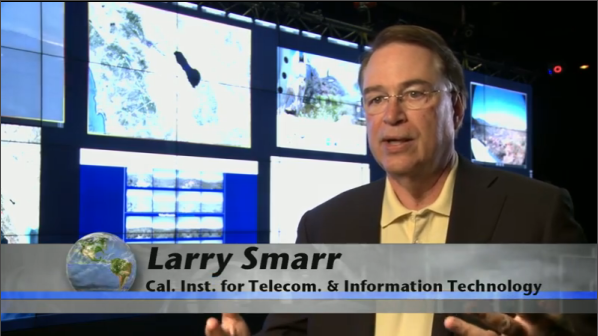
SAGE™ middleware, the Scalable Adaptive Graphics Environment, is being used by researchers to better convey related and relevant information to firefighters and disaster response teams, to better assist them in monitoring, forecasting and mitigating wildfires in the future
By Alexander Simes, on November 8, 2013
SAGE BIRDS OF A FEATHER (BOF): Scalable Adaptive Graphics Environment (SAGE) for Global Collaboration
Tuesday, November 19, 2013, 12:15PM – 01:15PM
Colorado Convention Center, Rooms 501/502
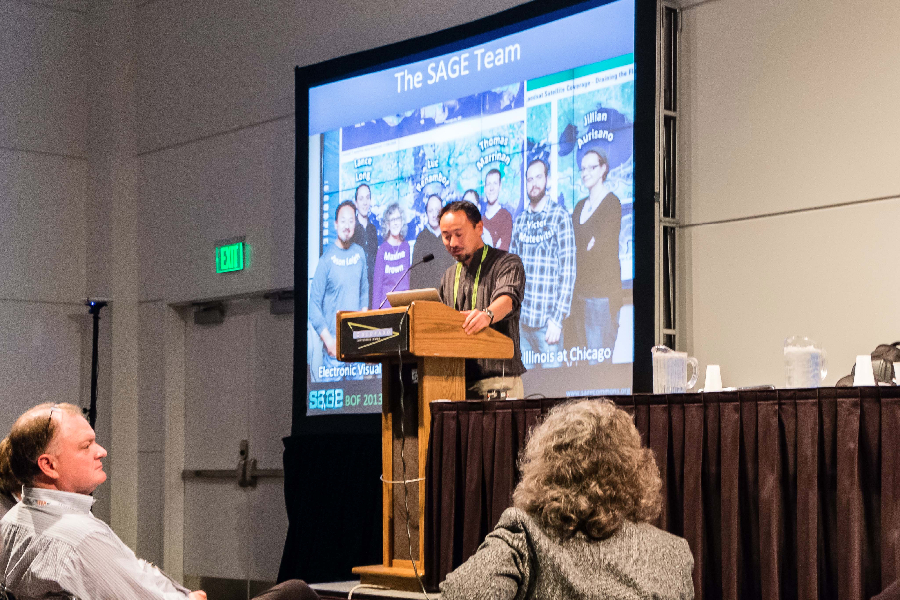
SAGE, the Scalable Adaptive Graphics Environment, receives major funding from the National Science Foundation to provide the scientific community with persistent visualization and collaboration services for global cyberinfrastructure. SAGE is a widely used open-source platform and the defacto operating system, or framework, for managing “big data” content on scalable-resolution tiled display walls. The SC BOF provides an unparalleled opportunity for the global SAGE user community, and potential users, to meet, review current development efforts, share community-developed use cases and applications, and have dynamic discussions on user requirements and future roadmaps
By Alexander Simes, on November 5, 2013
Newly-introduced hardware/software appliance enables professionals to display and manipulate Big Data analytics, 2D/3D images in variety of resolutions, formats; professionals to gain additional insights, discoveries
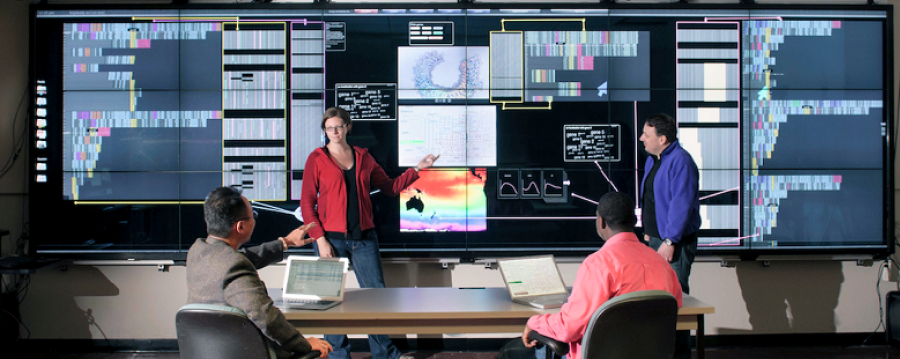
PHOTO: SAGE running on EVL’s Cyber-Commons tiled display wall. Courtesy of EVL, UIC. (Photo: Lance Long)
CHICAGO, IL, NOVEMBER 5, 2013 – Vadiza, the leading provider of advanced, integrated appliances for visualization and collaboration, and the University of Illinois at Chicago (UIC) today announced they have signed an agreement licensing SAGE™, UIC’s Scalable Adaptive Graphics Environment, for commercial sales, development and use on a global basis
By Luc Renambot, on October 22, 2013
SAGE installation and setup document now available.
PDF file: SAGE Documentation
By Alexander Simes, on July 8, 2013
July 8, 2013
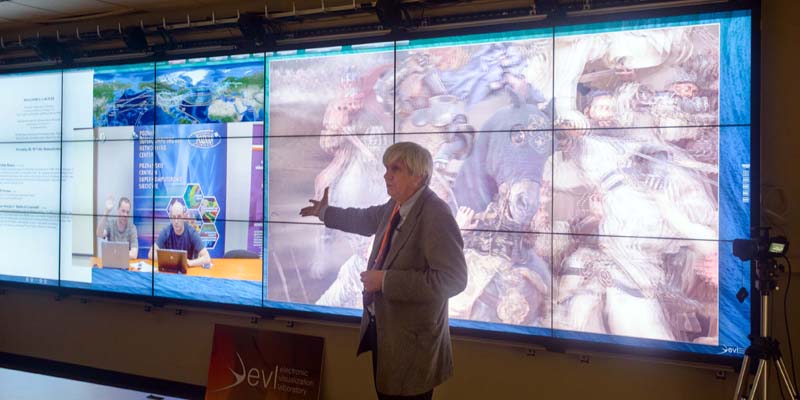
On June 25, 2013, in a special demonstration for the first annual US Ignite Application Summit held in Chicago in the U.S., computer scientists from Poland’s Poznan Supercomputing and Networking Center (PSNC) streamed ultra-high-resolution 3D movies over high-performance optical networks to the Electronic Visualization Laboratory (EVL) at the University of Illinois at Chicago (UIC). These films were “4K” resolution, a digital cinema standard that is slightly more than four times the resolution of high-definition television (HDTV)
By Alexander Simes, on June 21, 2013
Tuesday, November 13, 2012
Salt Palace Convention Center, Salt Lake City, UT
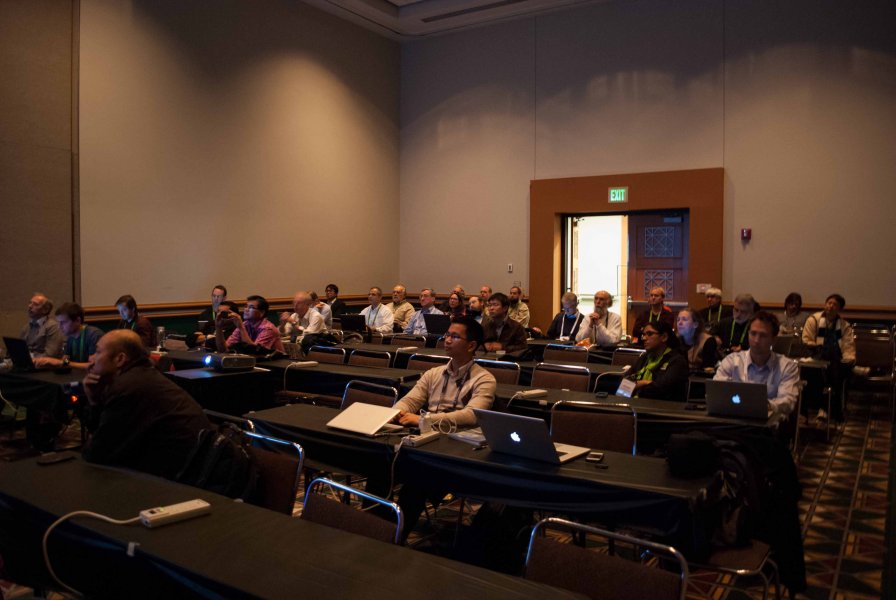
SAGE BIRDS OF A FEATHER (BOF): Scalable Adaptive Graphics Environment (SAGE) for Global Collaboration
SAGE, the Scalable Adaptive Graphics Environment, receives funding from the National Science Foundation to provide persistent visualization and collaboration services for global cyberinfrastructure. It is a widely used open-source platform and the scientific community’s defacto software operating environment, or framework, for managing content on scalable-resolution tiled display walls
By Alexander Simes, on October 16, 2012
Contact information:
Petr Holub, SITOLA/CESNET
petr.holub@cesnet.cz
OCTOBER 16, 2012
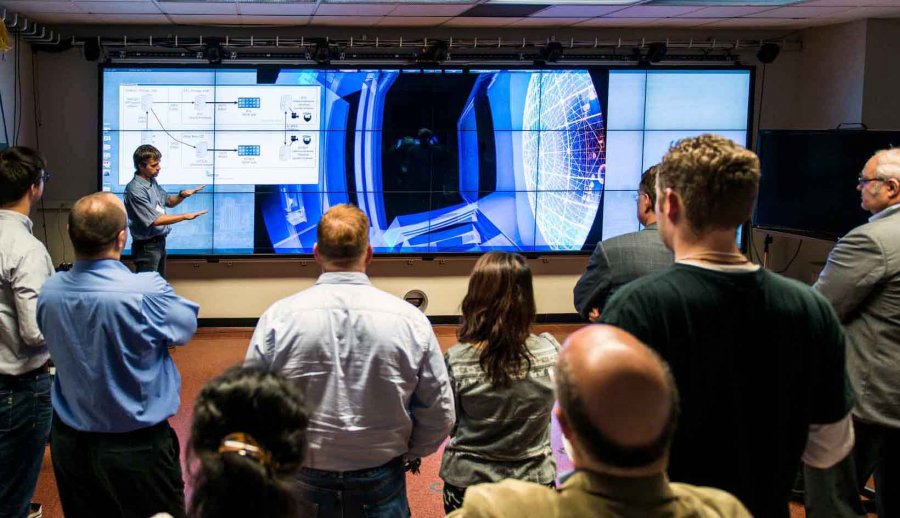
On October 11th, 2012, at the 12th Annual Global LambdaGrid Workshop in Chicago, sponsored by the Global Lambda Integrated Facility (GLIF), an international ultra-high-definition, high-performance, digital streaming application was showcased by researchers at the SITOLA laboratory at Masaryk University in the Czech Republic. To elevate digital media resolution to match the capabilities of human vision, which traditional media does not, 8K digital media (ultra-high-definition video with 16 times the resolution of common Full-HD video) was demonstrated. The size of these data streams is much higher than those that can be supported by today’s networks
By Alexander Simes, on November 22, 2011
SAGE BIRDS OF A FEATHER (BOF): Scalable Adaptive Graphics Environment (SAGE) for Global Collaboration
Tuesday, November 15, 2011
Washington State Convention and Trade Center (WSCC), Seattle, WA
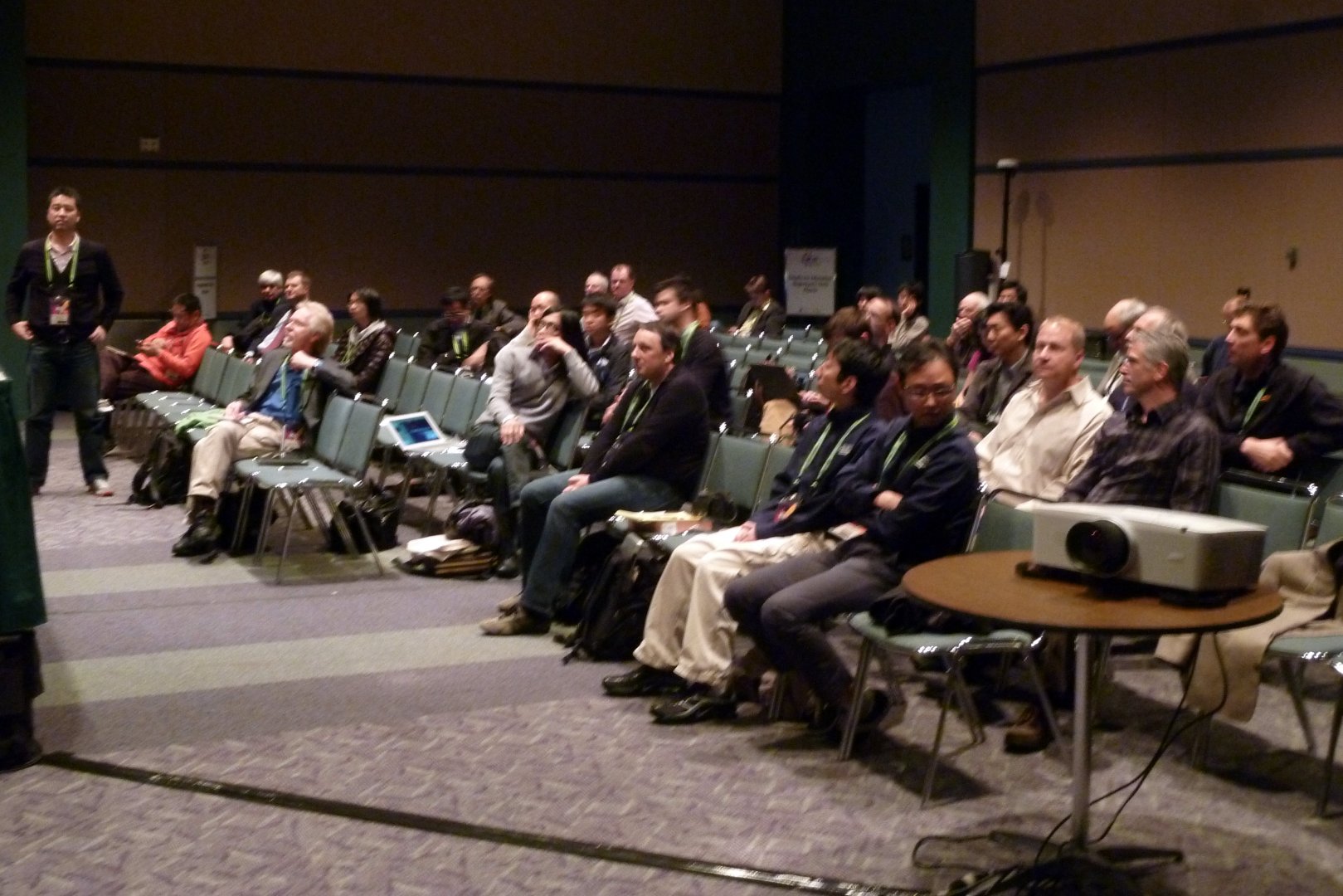
The SC11 SAGE BOF was the third annual meeting of the worldwide SAGE user community. It provided an opportunity for both current users as well as potential users to meet, discuss current and future development efforts, and share examples of
By Alexander Simes, on November 9, 2011
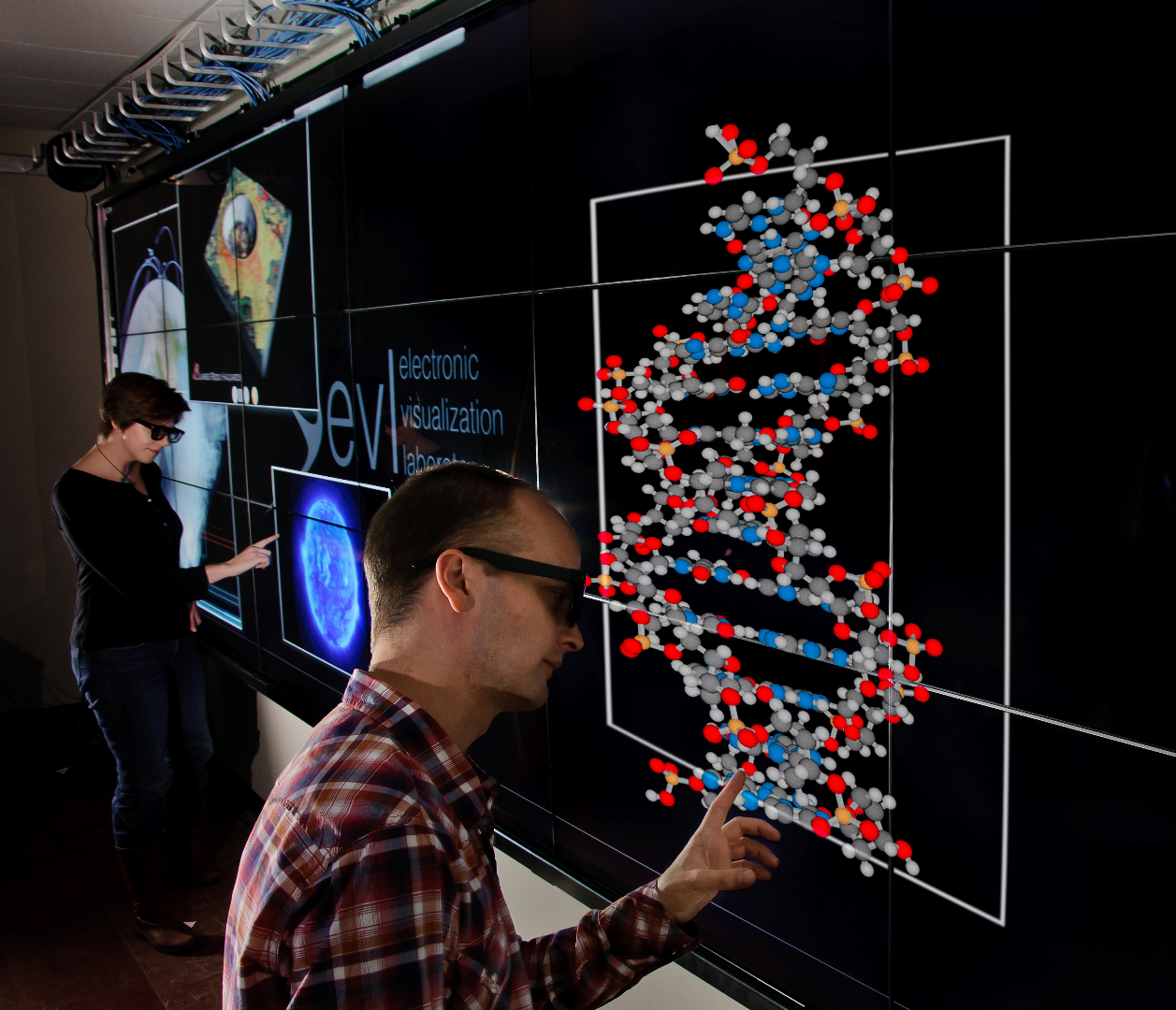
November 9, 2011
Seamlessly-tiled LCD flat-screen displays stretching floor-to-ceiling and wall-to-wall at the University of Illinois at Chicago’s Electronic Visualization Laboratory “Cyber-Commons” has served as a digitally-enhanced way to display, manipulate and exchange information and images since its opening in 2009. On November 11, EVL demonstrates Cyber-Commons’ latest enhancement – three-dimensional imagery, displayed along with traditional 2-D images.
“It’s a very powerful way to communicate ideas,” said Jason Leigh, UIC-EVL director and professor of computer science. “It lets people work together, make sense of lots of information and hopefully derive insights quicker. We’ve found it changes the way students work together.”
By Alexander Simes, on September 11, 2011
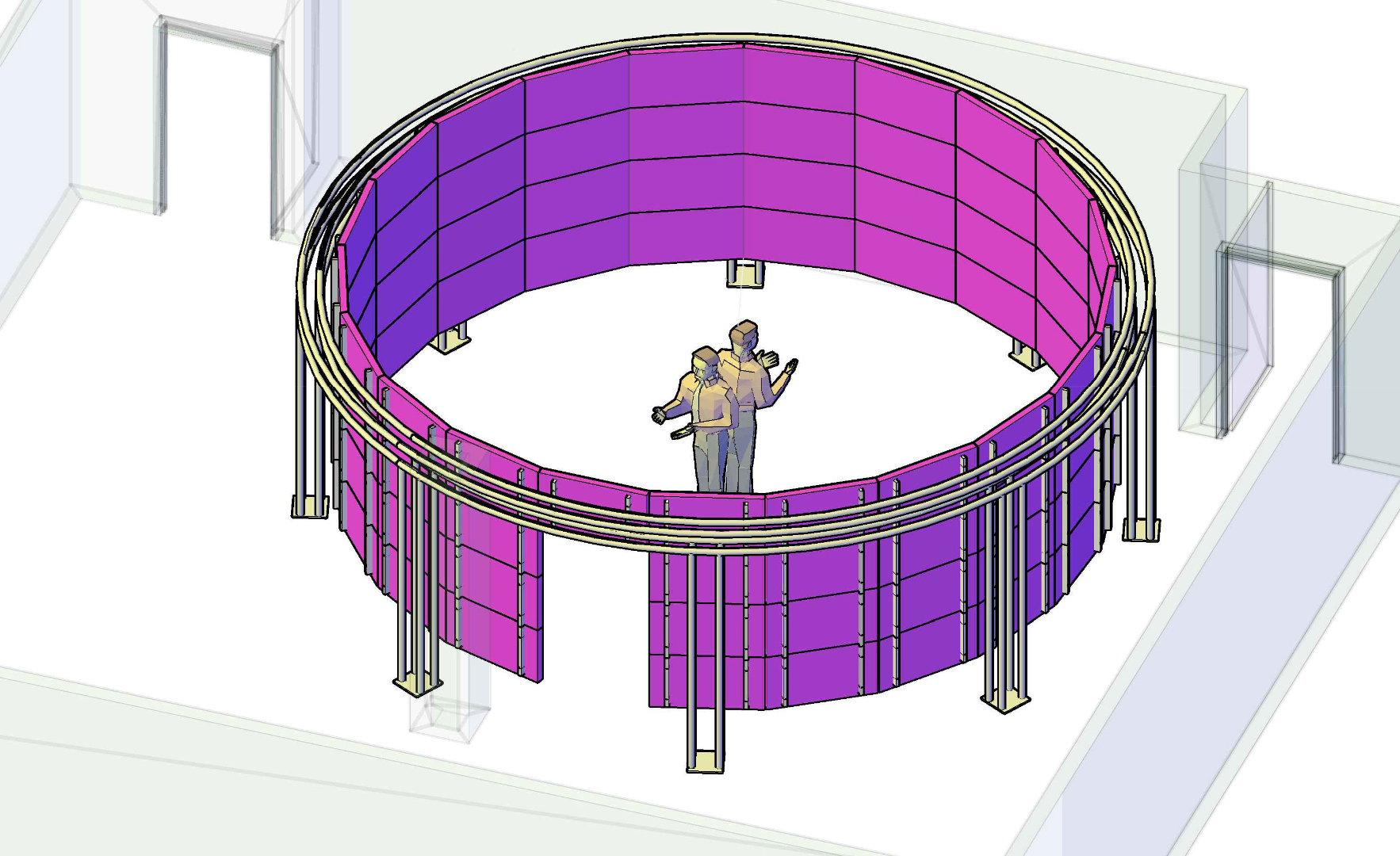
September 11. 2011
Developers: Andrew Johnson, Maxine Brown, Jason Leigh, Tom Peterka, Luc Renambot, Lance Long, Jonas Talandis, Daniel Sandin, Alan Verlo
CAVE2, is a scientific instrument that enables researchers to visualize data in a fully immersive 3D stereoscopic environment; it serves as the lense of a “telescope” or “microscope,” enabling them to see their e-science datasets that reside in cyberspace. Its development is being funded by the National Science Foundation’s Major Research Instrumentation (MRI) program
By Alexander Simes, on December 13, 2010
SAGE BIRDS OF A FEATHER (BOF): Scalable Adaptive Graphics Environment (SAGE) for Global Collaboration
November 16, 2010
Ernest N. Moriale Convention Center (ENMCC), New Orleans
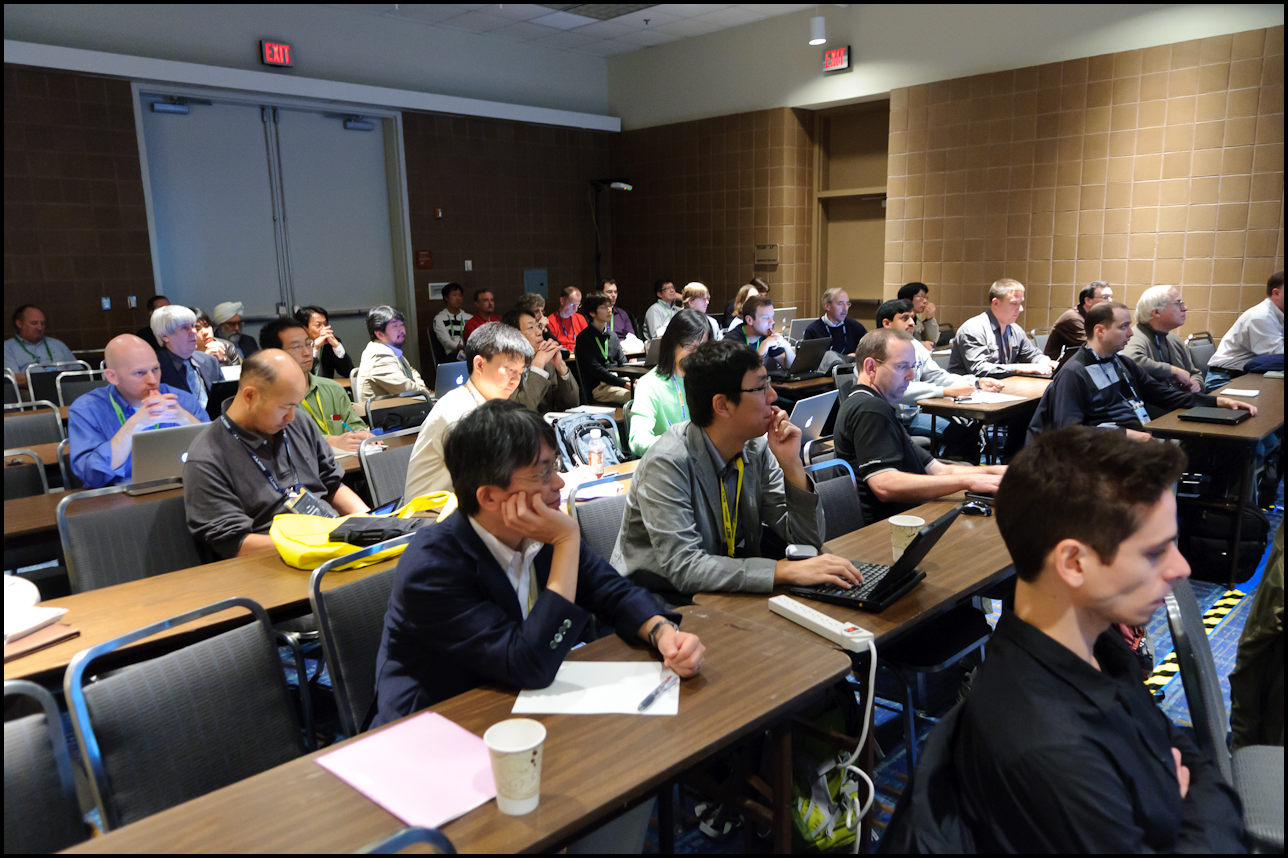
Today’s scientists are tackling issues of global priority – such as the environment, geoscience, bioscience, disaster response, and the physical nature of the universe, to name a few – and need the ability to view ultra-resolution images and/or create “cyber-mashups,”
By Alexander Simes, on December 1, 2010
The use of OptIPortal visualisation walls amongst Australian institutions has grown to a level where interaction beyond the usual point-to-point has become feasible. This has opened up interesting opportunities for multisite collaborations, which are now driving demand for stable middleware to manage such wall-to-multiwall interactions.
SAGE (Scalable Adaptive Graphics Environment), developed by the Electronic Visualization Laboratory (EVL) at the University of Illinois at Chicago, is a cross-platform graphics streaming architecture that is gaining broader acceptance in serving this purpose
By Alexander Simes, on August 4, 2010
22 October 2010
The 10th Annual Global LambdaGrid Workshop was held on the 13th and 14th of October 2010 at CERN in Geneva, Switzerland. The home of the Large Hadron Collider (LHC) was an appropriate venue as this multinational experiment is one of the biggest users of state-of-the-art optical networking, and also one of the most active participants in the GLIF community. Nearly 100 people attended the event, which included managers, engineers, researchers and developers from national research and education networks (NRENs), universities, research institutions and industry around the world
By Alexander Simes, on August 4, 2010
San Diego, Calif., July 26, 2010
Researchers at the University of California, San Diego (UCSD), the University of Illinois at Chicago, and Northwestern University have received a 3-year grant from the National Science Foundation (NSF) to encourage and enhance digital communication and collaboration between the U.S. and international science and engineering research and education communities. The award was announced at the GENI Engineering Conference, which showcased the NSF-funded research being conducted under the Global Environment for Network Innovations program.
The project, known as International Research Network Connections (IRNC) TransLight/StarLight, will enable multi-national collaborations by integrating high-performance networks with advanced data-intensive applications so that scientists and engineers can communicate with colleagues while simultaneously conducting major research projects. Researchers will, for example, be able to share data from instruments, sensors, high-definition cameras, data storage and computational resources located throughout the world
By Alexander Simes, on August 4, 2010
November 16, 2011
EDITOR’S NOTE: The UIC NEWS article “Learning in 3-D,” published November 16, 2011, announced the UIC Electronic Visualization Laboratory’s (EVL) new 3D version of its popular Cyber-Commons’ technology-enhanced classroom and meeting room.
The article explained that the technology used to build the Cyber-Commons 3D tiled display wall – 3D ultra-thin border, flat-panel displays – was developed by EVL in partnership with Planar Systems, an Oregon-based company. EVL received funding to work on this from a U.S. National Science Foundation economic stimulus grant. This collaboration proved mutually beneficial, as EVL got customized technology that surpassed what was commercially available, and Planar got a new product to market
By Alexander Simes, on August 4, 2010
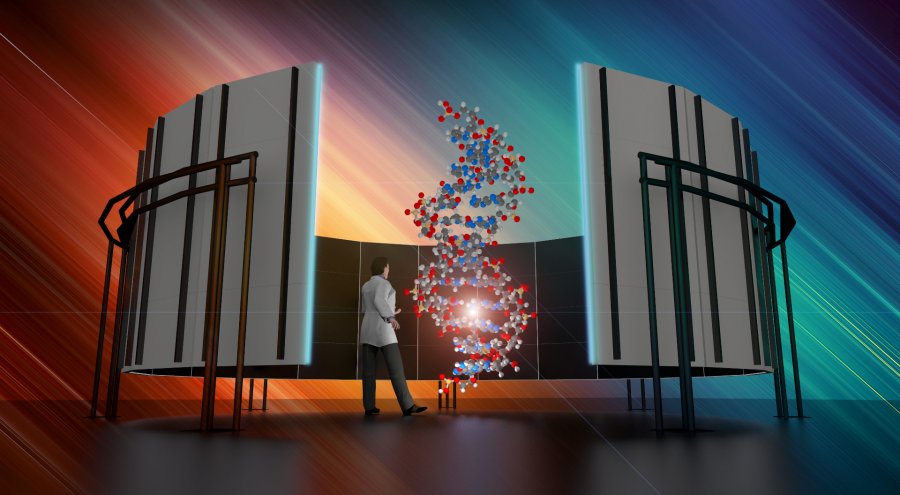
A scene in Star Wars. Life-like avatars. Cave Automatic Virtual Environment. They all germinated in UIC’s Electronic Visualization Lab. A place where the clock is always 15 years fast.
This article, by Stuart Luman, appeared in “UIC Alumni Magazine,” Winter 2011
By Alexander Simes, on July 7, 2010
Society for Information Display (SID)
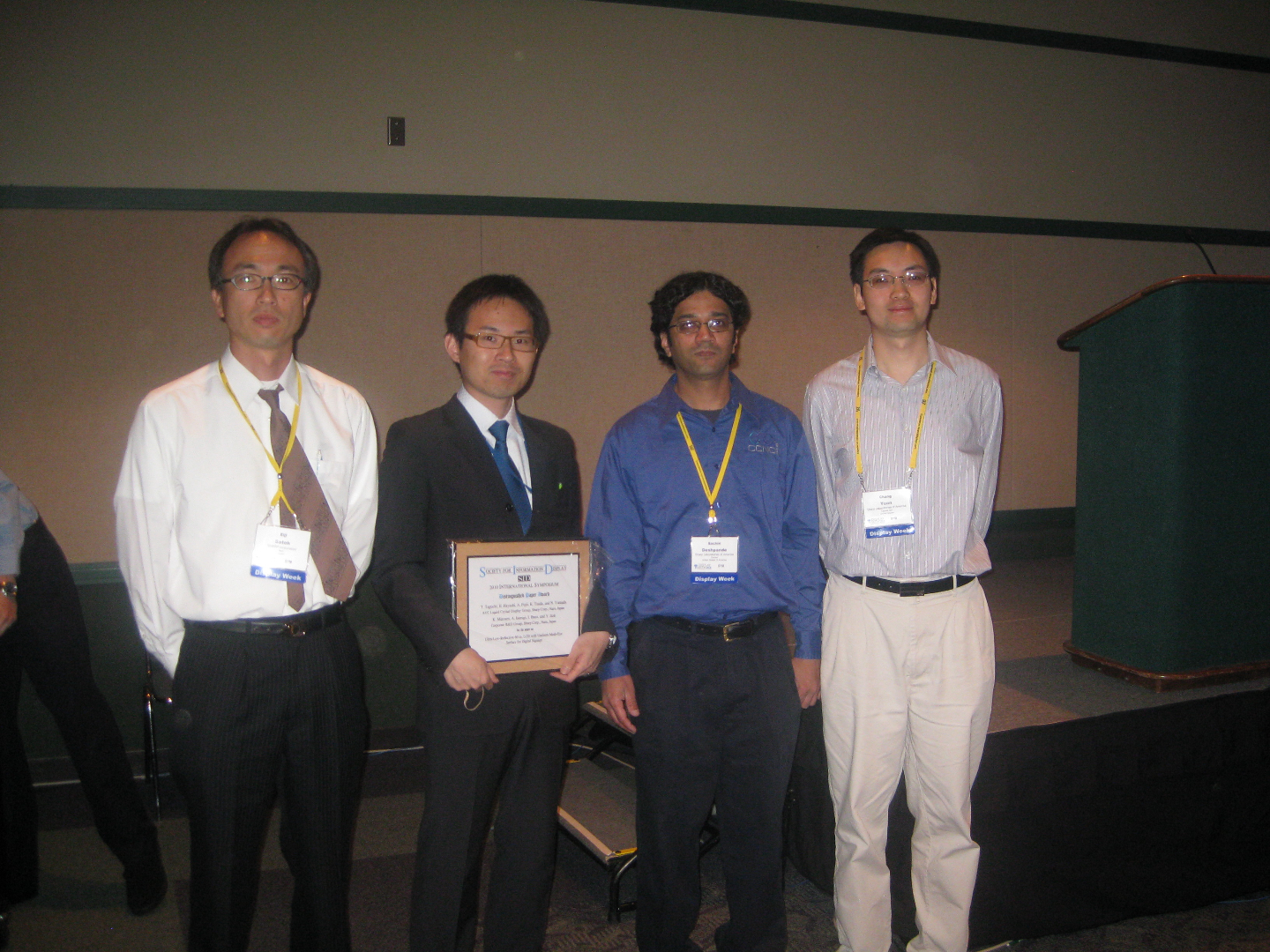
Sachin Deshpande (2nd from right) at SID 2010.
Seattle, Washington
May 23-28, 2010
The SID Symposium, held in Seattle, Washington, is the premier international gathering of scientists, engineers, manufacturers and users for the discussion, presentation, viewing and evaluation of information display technology. This year’s meeting featured a Digital Signage session in which Sachin Deshpande from Sharp Laboratories of America (SLA) talked about EVL SAGE advanced graphical user interface (GUI) research that SLA is funding. SLA is interested in issues of multiple simultaneous users (what Deshpande calls “advanced user interaction”) on the tiled wall display, producing both new display and audio technologies.
By Alexander Simes, on July 7, 2010
Knowledge Capital Trial 2010 Workshop
Osaka, Japan
June 9-10, 2010
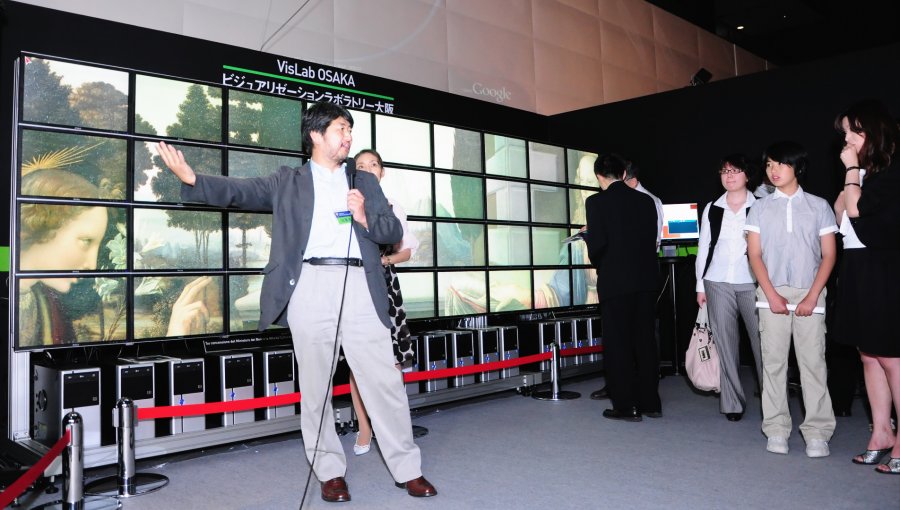
Dr. Shinji Shimojo (Senior Scientist, NICT), giving a presentation at Trial 2010 in front of the Osaka/VisLab tiled display.
On June 10 in Japan, a major event in Osaka to promote it as the Knowledge Capital of Japan featured SAGE Visualcasting demonstrations. Participants included the National Institute of Information and Communications Technology (NICT) in Tokyo, Osaka University’s VisLab, NCHC and NTUT in Taiwan, University of Queensland in Australia, and Calit2 in the US. EVL remotely operated the SAGE Wall at Calit2.
By Alexander Simes, on July 7, 2010
17th World Congress on IT (WCIT 2010)
Amsterdam, The Netherlands
May 25-27, 2010
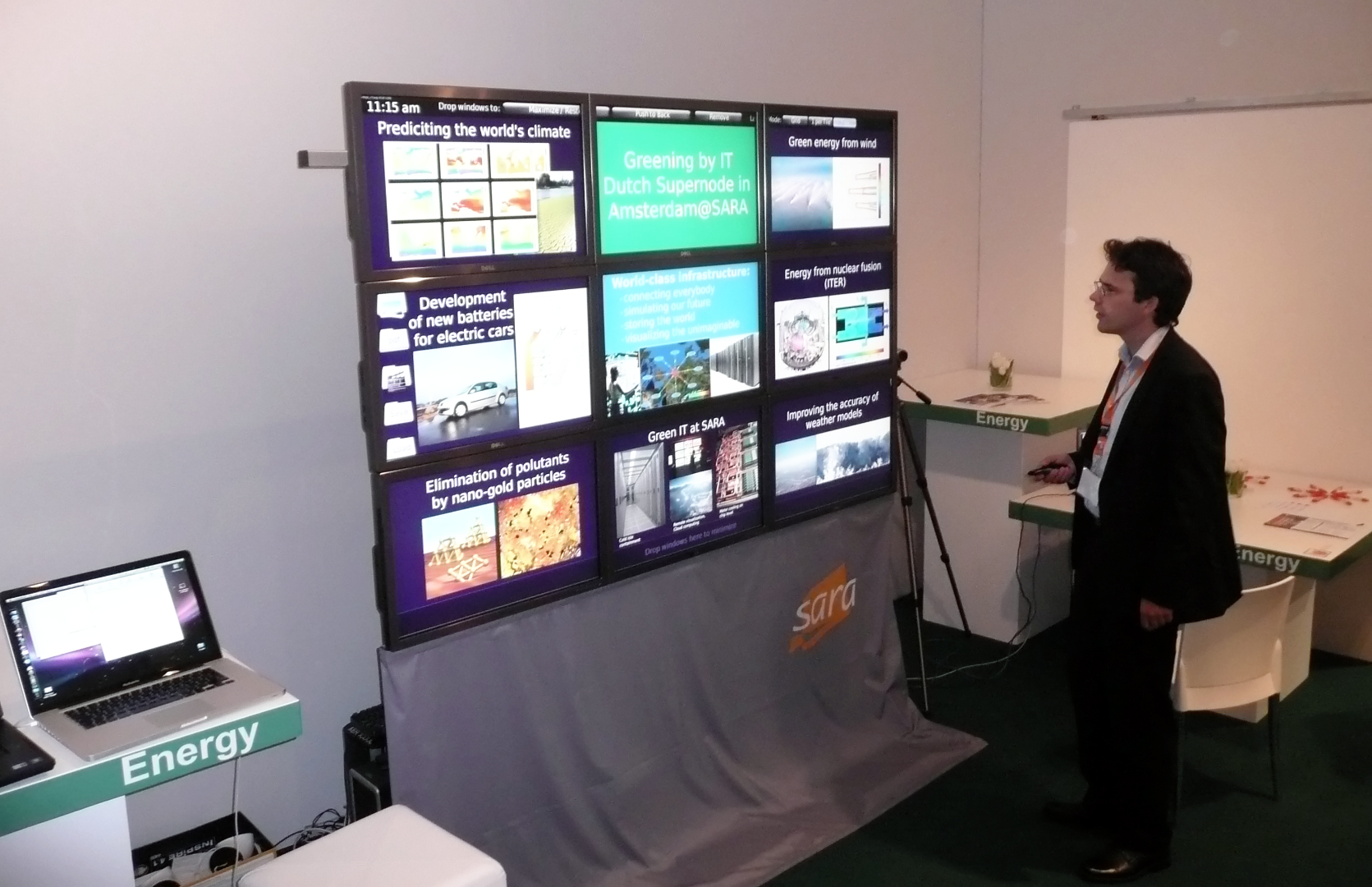
SARA booth at WCIT 2010.
SARA supercomputer center in The Netherlands did a major SAGE demonstration for the WCIT 2010 conference, showcasing applications developed in-house as well as by its users and guests. The theme of WCIT 2010 was Challenges of Change
By Alexander Simes, on July 7, 2010
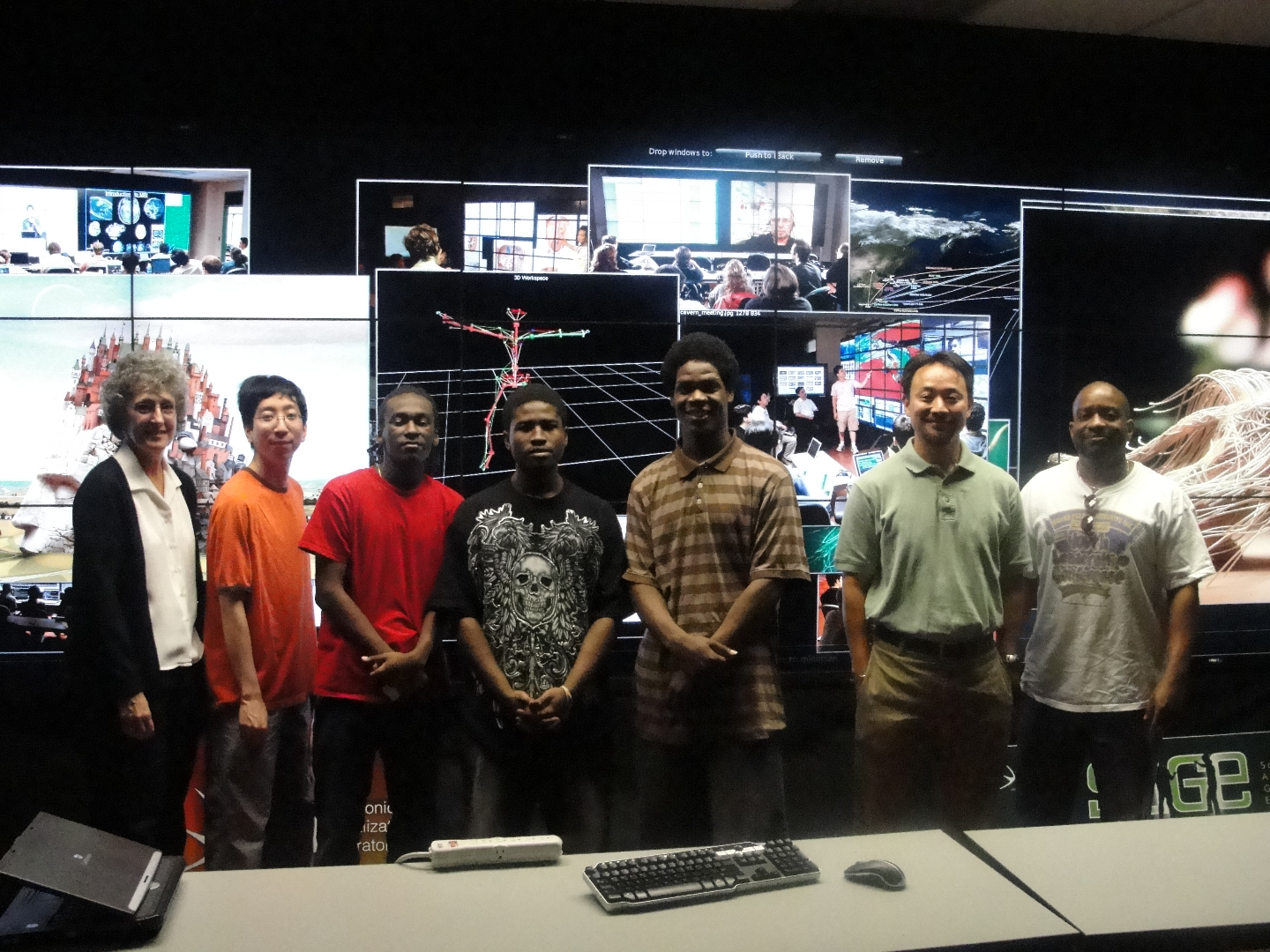
Standing in front of EVL’s Cyber-Commons wall are (left to right): EVL associate director Maxine Brown, EVL graduate student Arthur Nishimoto, 3 students from Austin Polytechnic High School, EVL director Jason Leigh, and Austin Polytechnic teacher Mel Slater.
Chicago, IL
June 18, 2010
The Electronic Visualization Laboratory does many tours, demos and presentations to assist the University of Illinois at Chicago (UIC) College of Engineering with minority education and recruitment programs. On June 18, 2010, EVL hosted a teacher and several of his students from Chicago’s Austin Polytechnic High School as part of the University of Illinois Affiliate Project Lead The Way (PLTW) program. This PLTW trip was organized by Dr. Wally Goncharoff of the UIC College of Engineering.
After the tour and discussions, the teacher sent an email to Dr. Goncharoff saying, “…the effect of your tour on their imaginations and positive conception of UIC cannot be overstated.”
By Alexander Simes, on July 7, 2010
Louisiana State University (LSU), Baton Rouge, Louisiana; National Center for Supercomputing Applications (NCSA), Champaign-Urbana, Illinois; Masaryk University, Brno, Czech Republic
September 15, 2009 – August 31, 2011 (ongoing)
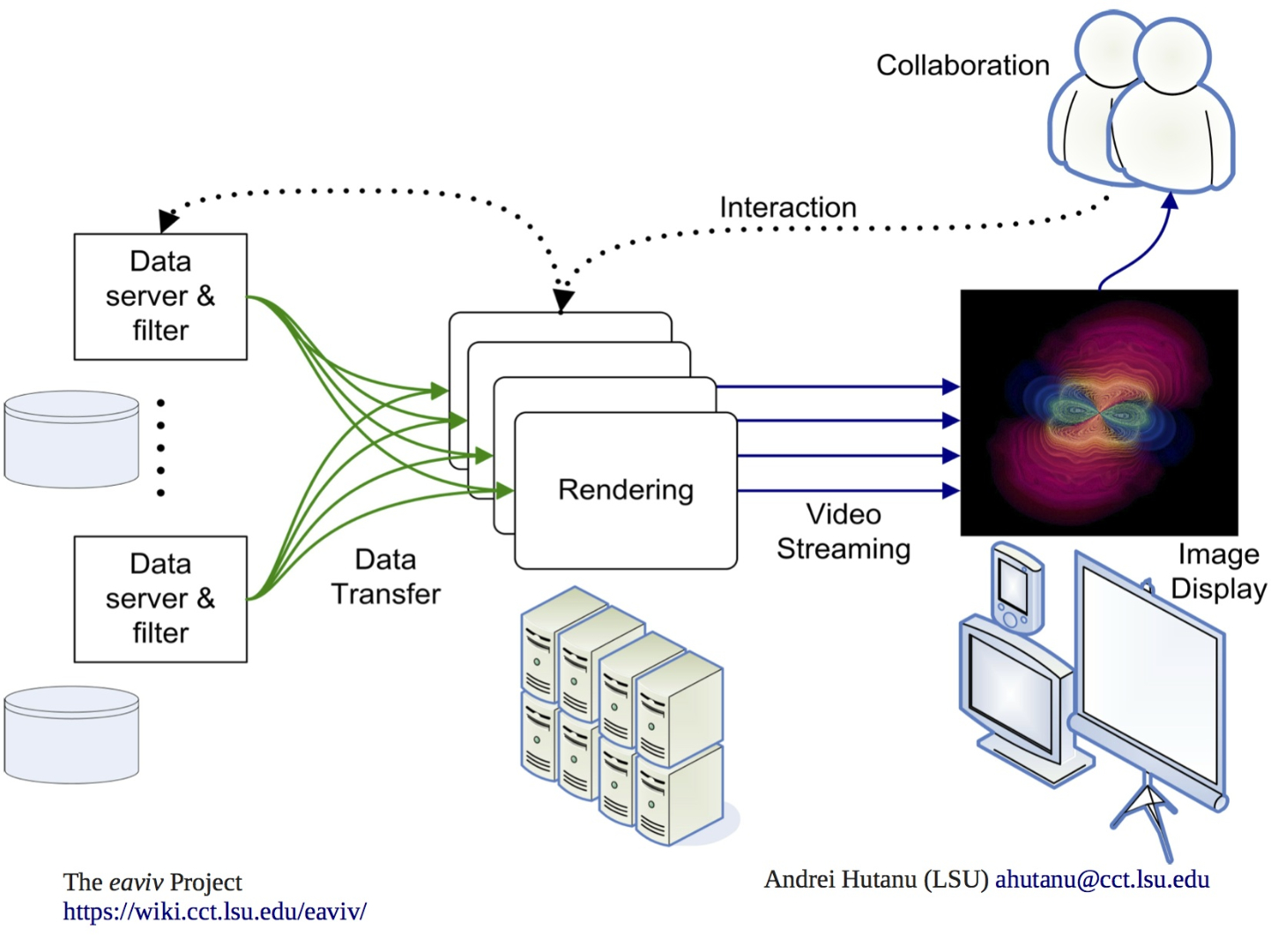
Excerpt from presentation by Andrei Hutanu at:
Internet2 Spring Member Meeting, April 2010
By Alexander Simes, on July 7, 2010
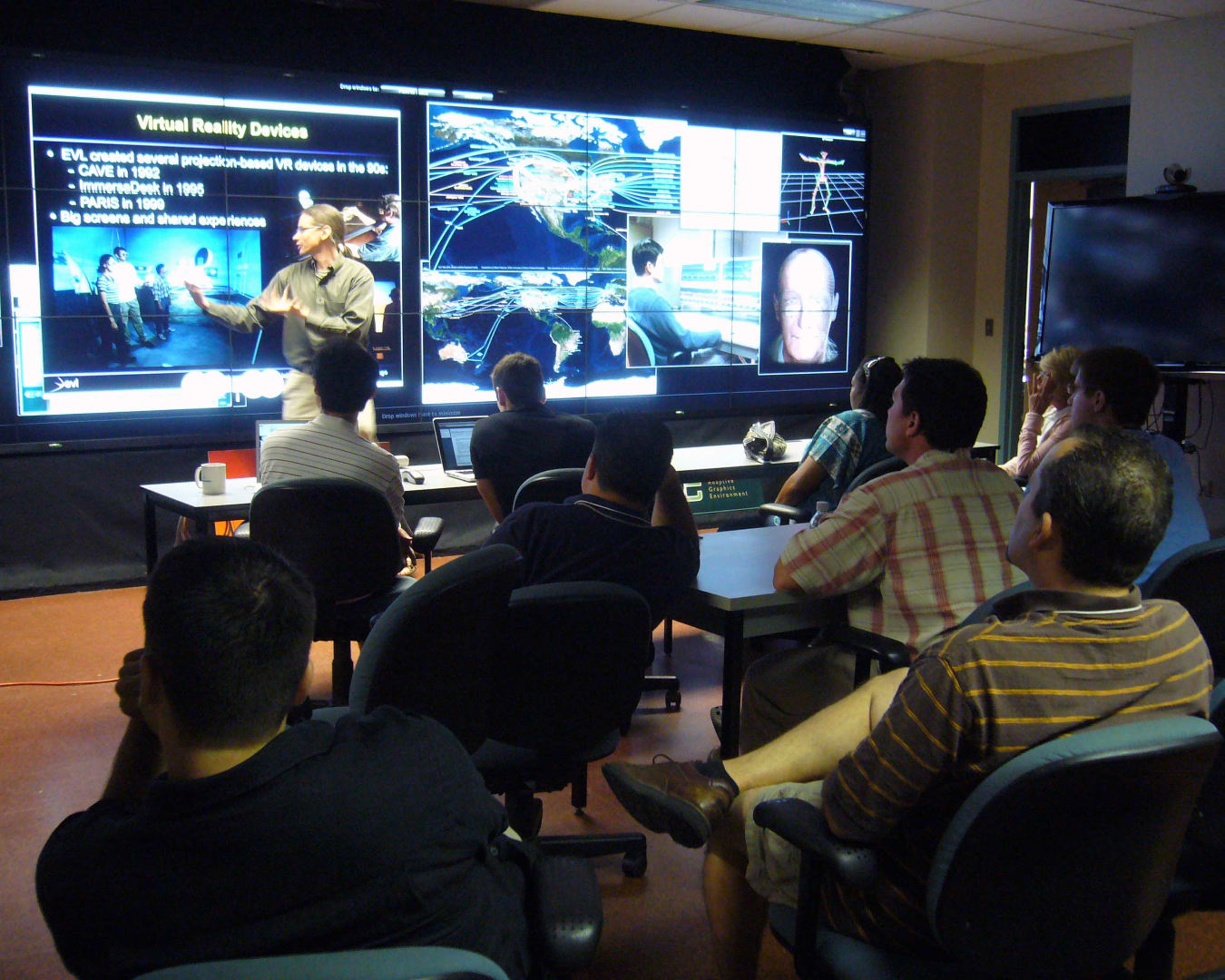
Dr. Andy Johnson uses SAGE to give an EVL overview presentation to Illinois PLTW STI teachers in EVL’s Cyber-Commons room.
UIC/EVL, Chicago, IL
July, 2010
On July 21, 2010, 30 math and science high-school teachers from four midwestern states toured EVL as part of a two-week intensive University of Illinois Summer Training Institute (STI), a continuing education program offered by the Illinois Project Lead The Way initiative. The University of Illinois became a PLTW National Affiliate University in 2005, offering STI sessions on its Chicago and Urbana-Champaign campuses, sponsoring statewide PLTW conference and professional development activities, coordinating program implementation and record keeping, and maintaining the statewide Illinois PLTW program website
By Alexander Simes, on July 7, 2010
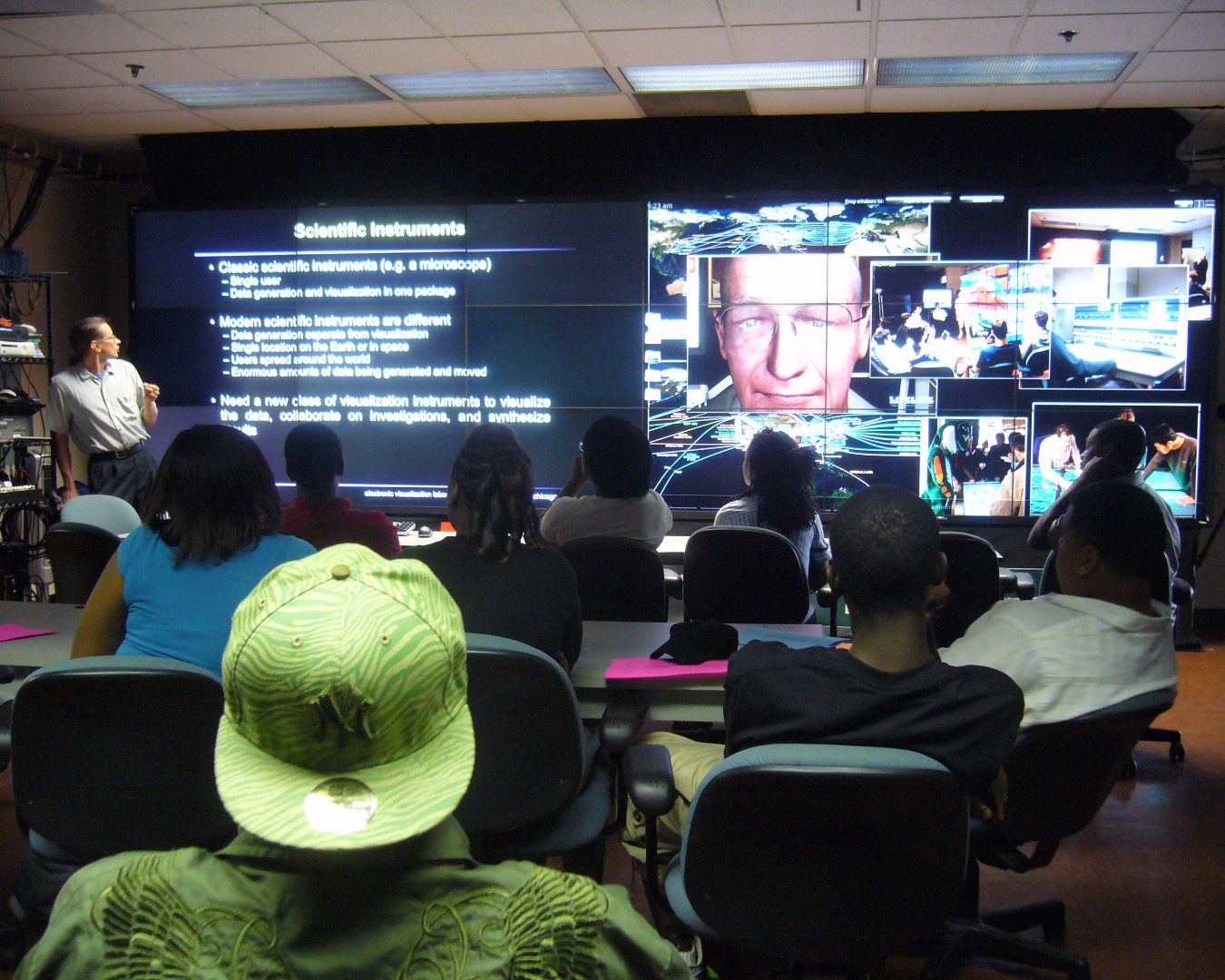
Dr. Andy Johnson giving a MERRP presentation using SAGE on the EVL Cyber-Commons wall.
UIC/EVL, Chicago, IL
July 9, 2010
On July 9, 2010, University of Illinois at Chicago (UIC) Associate Professor Andy Johnson of the Electronic Visualization Laboratory (EVL) and Computer Science Department gave a presentation of EVL’s visualization, virtual-reality and networking research to 20 students from the Chicago State University Minority Engineering program.
This presentation was one of several activities planned by Gerald A. Smith of the UIC College of Engineering’s Minority Engineering Recruitment & Retention Program (MERRP).
By Alexander Simes, on July 7, 2010
GreenLight Minority-Serving Institutions Cyberinfrastructure Coalition (MSI-CIEC) Workshop
Calit2/UCSD, San Diego, California
June 9-10, 2010
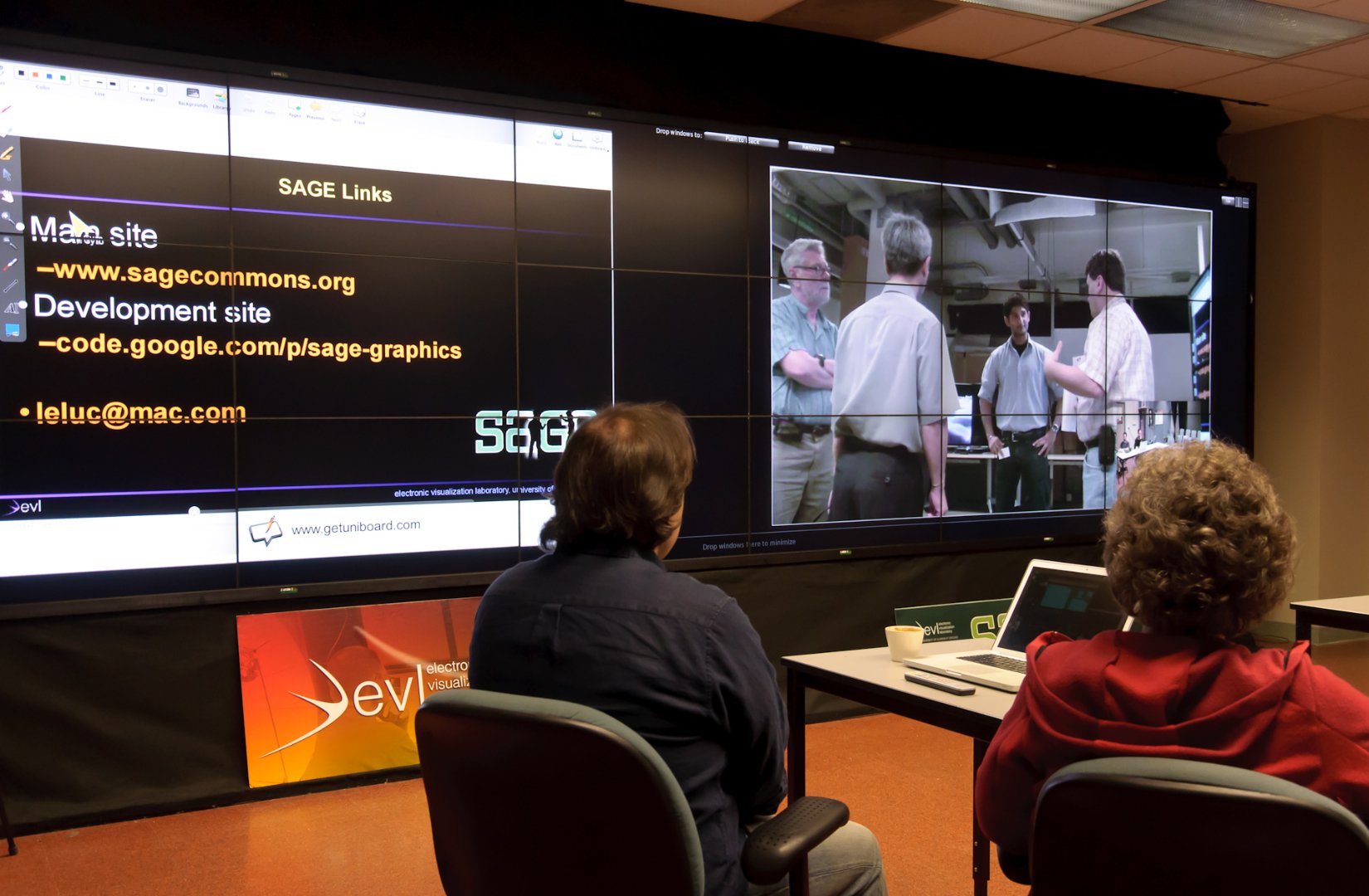
(Photo: Lance Long)
Luc Renambot (speaking), Maxine Brown, Sungwon Nam and Jason Leigh participated remotely from EVL in the MSI-CIEC Workshop. In this photo, taken at EVL, Renambot’s Powerpoints appear on the left side of the screen. MSI-CIEC attendees appear in the right-most display window.
The GreenLight MSI-CIEC Workshop, held at Calit2/UCSD, focused on the Calit2 NSF-funded GreenLight project on the first day, and focused on OptIPortals the second day. Demos featured a remote SAGE presentation and demo by Luc Renambot of the UIC Electronic Visualization Laboratory (EVL) to attendees in the Calit2 Virtulab in San Diego.
By Alexander Simes, on April 23, 2010
pragma18.pragma-grid.net
University of California San Diego (UCSD), San Diego, California
March 3-4, 2010
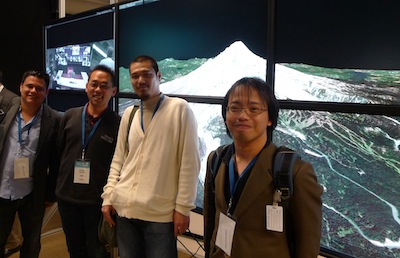
PRAGMA 18 SAGE demo between EVL and Calit2. Photo: Tom DeFanti
SAGE-PRAGMA-Proposal-max-100216a: SAGE Description – Maxine Brown, UIC/EVL
SAGE Demonstration
Luc Renambot, UIC/EVL and Joe Keefe, Calit2/UCSD
For this PRAGMA 18 demo, data was streamed from a storage server located at StarLight to the SAGE tiled display wall at Calit2. In particular, EVL streamed an animation of Mt. Hood, Oregon, created by PRAGMA member and SAGE user AIST (National Institute of Advanced Industrial Science and Technology) of Japan. EVL and Calit2 were also connected via Polycom (output directed to the tiled display wall) so the two groups could talk to one another.
By Alexander Simes, on April 23, 2010
www.mmsys.org
Scottsdale, Arizona
February 22-23, 2010
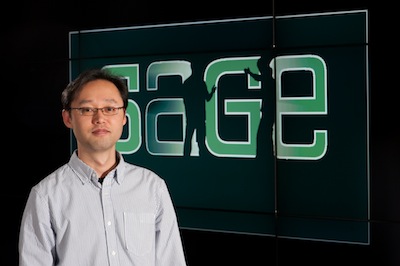
PhD candidate, Sungwon Nam. Photo: Lance Long, UIC/EVL
EVL PhD candidate Sungwon Nam presented the paper “Multiapplication, Intertile Synchronization on Ultra-High-Resolution Display Walls,” by Sungwon Nam, Sachin Deshpande, Venkatram Vishwanath, Byungil Jeong, Luc Renambot and Jason Leigh, at the ACM Multimedia Systems 2010 conference. It described two SAGE synchronization algorithms and approaches to achieve low-latency, inter-tile synchronization for multiple applications with independently varying frame rates.
By Alexander Simes, on April 23, 2010
www.apan29.net
Asia-Pacific Area Network (APAN) 29th conference, Sydney, Australia
February 8-11, 2010
QCIF and UQVislab Demonstrate AARNet’s SAGE Bridge and 5Gbps throughput at APAN29
www.vislab.uq.edu.au/research/optiputer/APAN29/
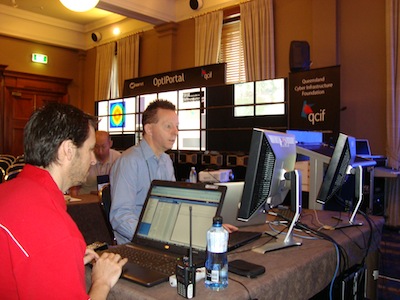
University of Queensland (Brisbane, Australia), University of Melbourne (Victoria, Australia), GIST (Korea) and TACC (US) participated in a SAGE Visualcasting demo at APAN29. Photo: Bernard Pailthorpe, Queensland
The Asia-Pacific Area Network (APAN) 29th conference, APAN29, held February 8-11, 2010 in Sydney, Australia and hosted by AARNet, Australia’s Academic and Research Network, featured two major SAGE demonstrations that set new records for customer-generated data flows across the AARNet backbone
By Alexander Simes, on April 23, 2010
www.kaust.edu.sa/academics/wep/
King Abdullah University for Science and Technology (KAUST), Saudi Arabia
January 30 – February 3, 2010
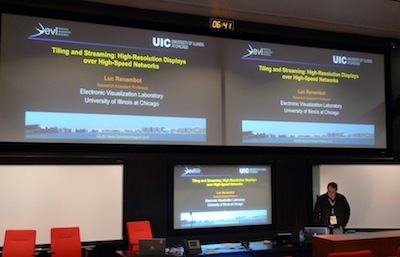
Luc Renambot teaching at the KAUST WEP 2010. Photo: Tom DeFanti
The Winter Enrichment Program (WEP) is a month-long semester designed for the entire KAUST community to enlarge its intellectual horizons and stretch its collective imaginations. The WEP featured more than 100 courses, workshops, seminars, lectures and recreational events that enriched faculty/student minds and lives. Visualization Workshops took place during a one-week period, conducted by several researchers from Calit2/UCSD, UIC/EVL and KAUST.
WEP-2010-renambot: Streaming Televisualization (SAGE) Workshop – Luc Renambot, UIC/EVL and Greg Wickham, KAUST
Workshop topics included virtual-reality devices, managing scale and complexity, scientific needs for working with large datasets and data fusion, high-resolution displays connected to high-speed networks, display border management, multi-touch tables, international networking infrastructure, OptIPuter, the TransLight/StarLight project, ROCKS clusters, SAGE, and remote rendering and parallel pixel streaming with ParaView and SAGE.
By Alexander Simes, on April 23, 2010
By Alexander Simes, on April 23, 2010
Sponsored by NTT Network Innovation Laboratories; Hosted by Calit2/UCSD, San Diego, California
February 7-9, 2010
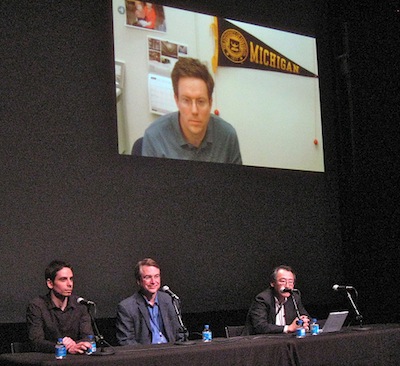
Ratko Jagodic (seated far left) participating in the ONVECTOR CSCW panel. Photo: Natalie Van Osdol*
ON*VECTOR (Optical Networked Virtual Environments for Collaborative Trans-Oceanic Research) is a joint project of NTT Network Innovation Laboratories, Keio University’s Institute for Digital Media and Content (DMC), the University of Tokyo’s Morikawa Laboratory, the University of Illinois at Chicago’s (UIC) Electronic Visualization Laboratory (EVL), and the California Institute for Telecommunications and Information Technology (Calit2) at the University of California, San Diego (UCSD), and managed by Pacific Interface Inc (PII).
ONVECTOR2010-CSCW-Jagodic: Improving SAGE Capabili ties for Computer Supported Cooperative Work (CSCW) – Ratko Jagodic, UIC/EVL (One of 4 speakers in a CSCW panel.)
ONVECTOR2010-CSCW-Jagodic-SAGE Interaction Youtube: Movie: SAGE Interaction
By Alexander Simes, on February 28, 2010
APAN Claims Domestic and World Firsts
2/11/10
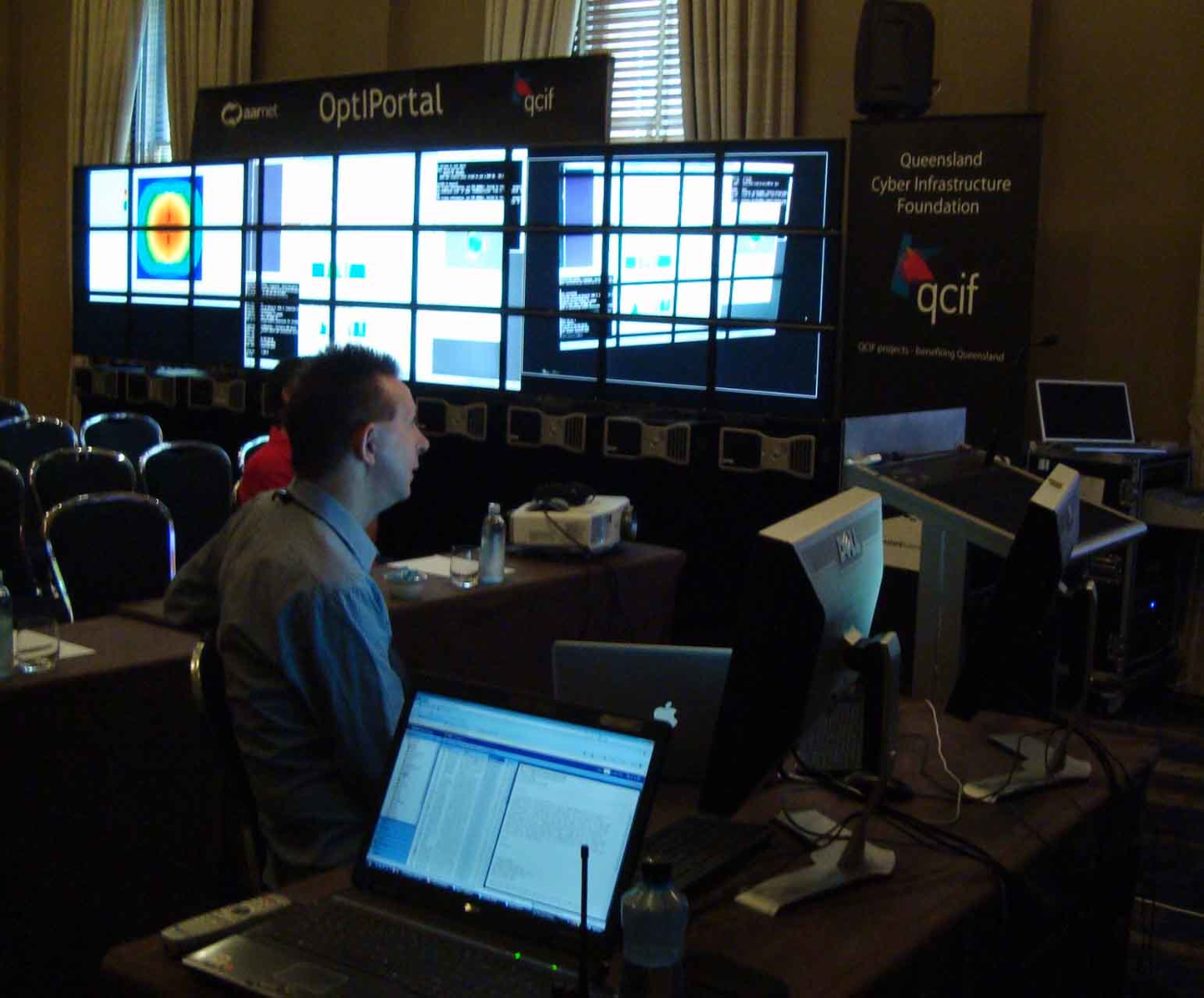
Sydney, AUSTRALIA – 11 February 2010 – [AARNet] Organisers of the 29th Asia Pacific Advanced Networking Consortium meeting (APAN) held in Sydney earlier this week are claiming a handful of Australian and world firsts. Speaking to Computerworld, Australia’s Academic and Research Network (AARNet) CEO Chris Hancock pointed to telemedicine, IPv6 and Eduroam (a location independent wireless network) demonstrations as highlights
By Alexander Simes, on February 28, 2010
Sydney, AUSTRALIA – 11 February 2010
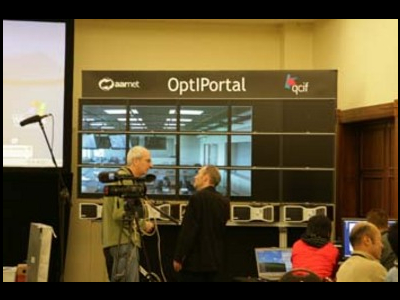
AARNet, Australia’s Academic and Research Network has joined forces with the University of Queensland, Queensland Cyber Infrastructure Foundation (QCIF) to offer Australia’s first SAGE Bridge to support the multidirectional streaming (or visualcasting) of ultra high resolution videos and images at up to five Gigabits per second (Gbps).
Used to support global collaboration among co-located and remote experts who require interactive ultra-high-resolution imagery, delegates at the 29th Asia Pacific Advanced Networking Consortium meeting (APAN) in Sydney were shown a live multidirectional visualcast on an OptiPortal connected to AARNet’s high speed network. The demonstration connected participants from QCIF at the University of Queensland, University of Melbourne, Texas Advanced Computing Centre (USA), Gwangju Institute of Science and Technology (South Korea) and APAN
By Alexander Simes, on December 28, 2009
Display walls of any size – whether digital cinema animations, high-resolution images, high-definition video-teleconferencing, presentation slides, documents, spreadsheets or laptop screens.
NSF believes this important, and recently awarded University of Illinois at Chicago’s Electronic Visualization Laboratory (EVL) a 3-year grant to transition SAGE from a research prototype to a hardened technology for cyberinfrastructure. EVL’s goal is to develop production-quality, community-driven, open services for visualization and collaboration, foster the growth of the burgeoning SAGE user community, and create a forum for developers and users to contribute new tools, capabilities and applications
By Alexander Simes, on December 28, 2009
CineGrid International Workshop 2009
12/6/09 – 12/9/09
San Diego, CA
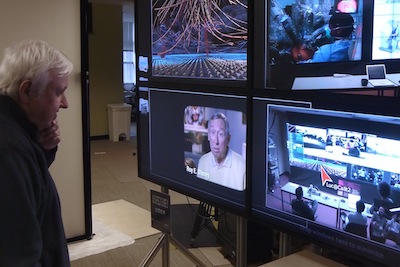
SAGE demonstration at CineGrid Workshop (image courtesy Luc Renambot, EVL)
The 4th CineGrid International Workshop was held December 6-9, 2009 at the California Institute for Telecommunications and Information Technology (Calit2), University of California San Diego. The Workshop brought together technologists, researchers and industry leaders to discuss and demonstrate the latest developments and research in networked collaborative tools to enable the production, use and exchange of very high-quality digital media over photonic networks
By Alexander Simes, on December 27, 2009
Ultra-high-speed, made ultra-easy
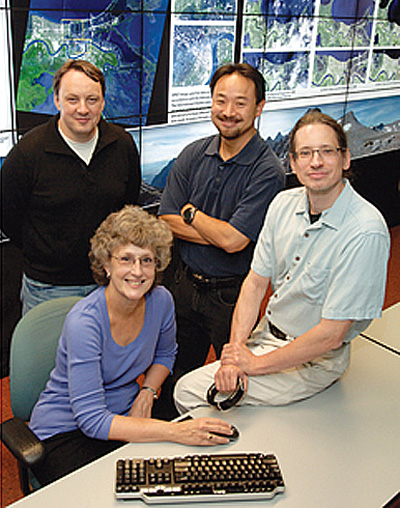
Luc Renambot, Jason Leigh, Maxine Brown & Andy Johnson (image courtesy Roberta Dupuis-Devlin, UIC Publication Services).
10/14/09
UIC News
The University of Illinois at Chicago (UIC) Electronic Visualization Laboratory (EVL) was recently awarded a three-year, $1.9-Million grant from the National Science Foundation (NSF) for “OptIPlanet Cyber-Mashup,” to create persistent visualization and collaboration services for global cyberinfrastructure. The award will enable EVL to further develop, enhance and deploy its popular Scalable Adaptive Graphics Environment (SAGE) middleware to a burgeoning international user community.
Read the complete article on UIC News
By Alexander Simes, on December 11, 2009
SC09 BIRDS OF A FEATHER (BOF): Next Generation Scalable Adaptive Graphics Environment (SAGE) for Global Collaboration
Oregon Convention Center, Portland, Oregon
November 17, 2009
SAGEUser SC09 Placard: SAGE USER SIGNAGE
sc09.supercomputing.org
scyourway.supercomputing.org/conference/view/bof195
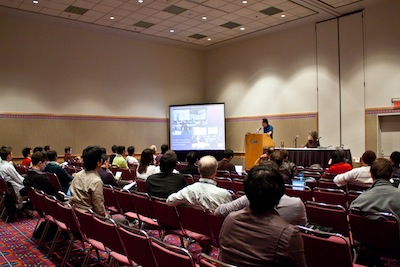
SC09 SAGE BOF. Photo: Ratko Jagodic, UIC/EVL
By Alexander Simes, on December 8, 2009
8/18/09
Chicago, IL
The National Science Foundation has awarded the Electronic Visualization Laboratory’s proposal STCI: OptIPlanet Cyber-Mashup: Persistent Visualization and Collaboration Services for Global Cyber Infrastructure. The $1,933,337 award was made on 08/18/09 for a three year period beginning 9/1/09. Principal investigator, Jason Leigh with co-PIs – Computer Science associate professor Andrew Johnson, research assistant professor Luc Renambot, and EVL associate director Maxine Brown will direct research efforts focused on the development and enhancement of cyberinfrastructure technology for large-scale data visualization and collaboration in science and engineering.
The goal of this project is to accelerate the growth of a burgeoning community of international institutions that have adopted OptIPortals – ultra-resolution visualization display instruments interconnected by high-speed networks